Trading Psychology: Why Your Mindset Is the Key to Consistent Profits
The emotional hurdles every trader faces—and how to build a bulletproof mindset.
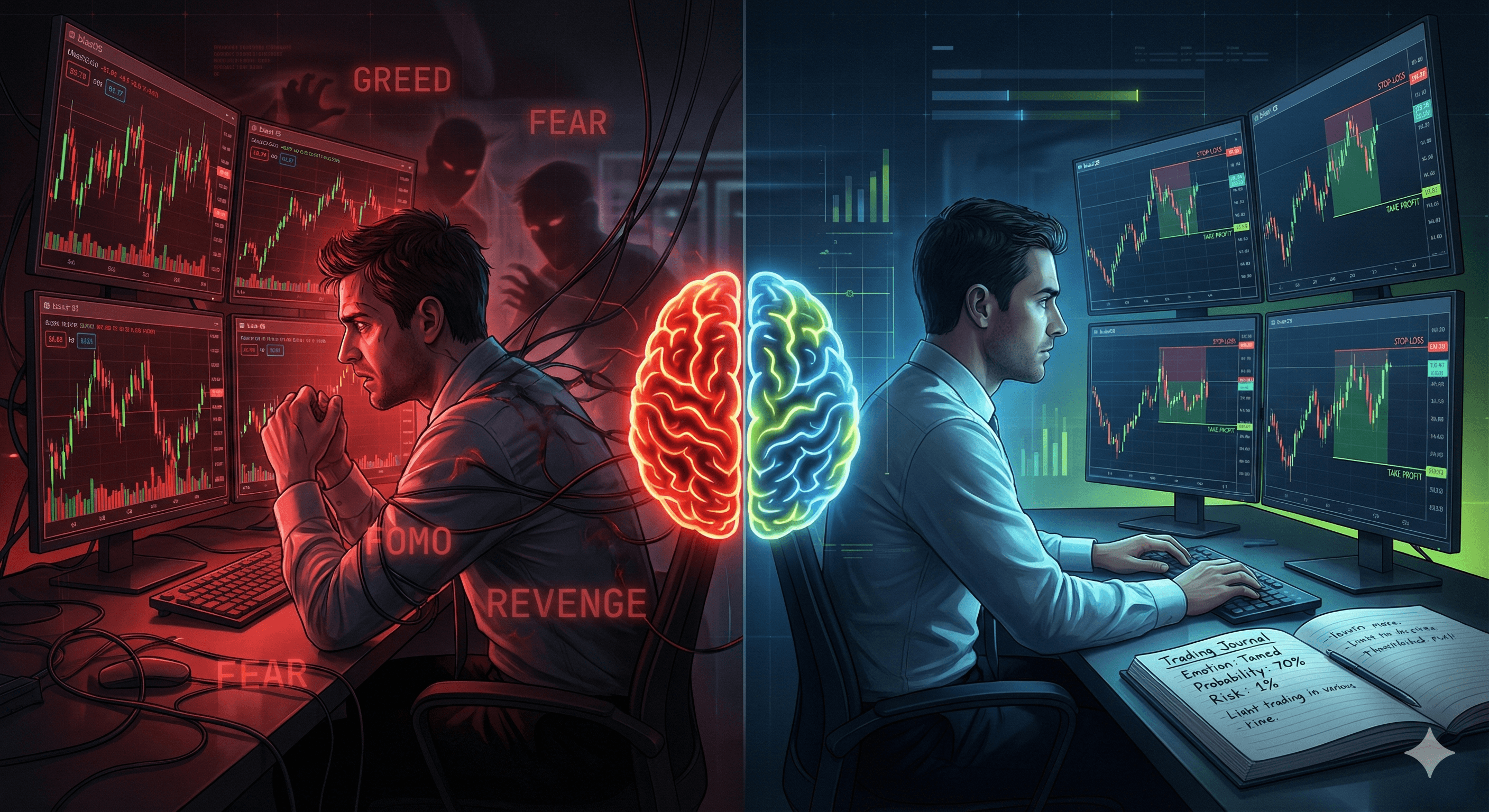
You can have the most expensive charting software, a high-probability strategy, and a perfectly funded account—but if your mind isn't right, you will likely lose money.
In the trading world, it is often said that success is 20% strategy and 80% psychology. While technical analysis tells you where the market might go, trading psychology dictates how you react to what the market actually does.
In this guide, we'll explore the emotional hurdles every trader faces and how to build a bulletproof mindset.
The "Four Horsemen" of Trading Emotions
To master your psychology, you must first identify the emotions that lead to self-sabotage. Most trading errors can be traced back to four specific feelings:
1. Greed
Greed often appears when you are winning. It convinces you to ignore your trading plan, stay in a position too long hoping for "just a bit more," or increase your position size to an unsafe level.
- The Result: A winning trade turns into a losing one because you failed to take profits when your plan told you to.
2. Fear
Fear usually kicks in after a loss or during high volatility. It manifests as hesitation—you see a perfect setup, but you're too "scared" to click the button.
- The Result: You miss out on profitable opportunities, leading to frustration and further emotional instability.
3. FOMO (Fear Of Missing Out)
We've all seen a stock or crypto coin "moon" and felt the urge to jump in late. FOMO is the impulse to enter a trade because you see others making money, even if the entry point is no longer valid.
- The Result: You buy at the top, just as the professional traders are selling their positions.
4. Revenge Trading
This is perhaps the most dangerous emotion. After a loss, you feel an angry urge to "get your money back" immediately. You take a trade that doesn't fit your criteria, often with double the risk, just to break even.
- The Result: A small, manageable loss turns into an account-destroying catastrophe.
Why Our Brains Aren't Wired for Trading
Human evolution has programmed us for survival. When we face a threat, our "fight or flight" response (the amygdala) takes over. In the wild, this saved our lives. In the markets, this response is a liability.
When you see your account balance dropping, your brain perceives it as a physical threat. This causes your prefrontal cortex—the part of the brain responsible for logic and long-term planning—to shut down. You stop thinking like a strategist and start acting like a cornered animal.
The key to professional trading is learning to override these primitive instincts with logic.
Practical Strategies to Master Your Mindset
1. Trade with "Risk Capital" Only
You cannot think clearly if you are trading with money you need for rent. Emotional pressure scales with the importance of the money. Only trade with capital that you are truly prepared to lose.
2. Think in Probabilities, Not Certainties
Amateur traders focus on the outcome of the next trade. Professionals focus on the outcome of the next one hundred trades. When you realize that any single trade is just one data point in a large sample size, the emotional weight of a single loss disappears.
3. The "20-Minute Rule"
If you feel a surge of anger (Revenge) or excitement (Greed), step away from the screen for at least 20 minutes. Physical distance from the charts allows your logical brain to regain control over your emotional brain.
4. Use a Trading Journal
A journal is a mirror for your mind. Document not just your entries and exits, but how you felt during the trade. Over time, you will see patterns: "I always lose money when I trade before my morning coffee" or "I tend to break my rules on Friday afternoons."
Transitioning from Gambler to Professional
A professional trader treats their craft like a business. They understand that losses are simply the "cost of doing business," much like a restaurant owner views spoiled food as an expense.
To build this mindset:
- Detach from the money: Focus on executing your plan perfectly. If you followed your rules and lost money, that was a "good trade." If you broke your rules and made money, that was a "bad trade" because it reinforced bad habits.
- Maintain physical health: Your mental state is tied to your physical state. Lack of sleep, poor diet, and high stress levels significantly degrade your decision-making ability.
Conclusion: The Quiet Edge
In a world of high-speed algorithms and complex indicators, a calm mind is the ultimate "edge." While others are panicking, the disciplined trader remains objective. Mastering your psychology won't happen overnight, but it is the most rewarding investment you will ever make in your trading career.
Key Takeaways:
- Identify your triggers: Know whether you lean toward fear or greed.
- Stick to the plan: Discipline is the antidote to emotion.
- Step away: Don't let the market dictate your mood.
- Journal everything: Data is the best way to remain objective.